







What is a media converter used for?
When service providers deploy a new connection or upgrade a network, they often face the challenge of how to integrate with the customer’s existing copper infrastructure or extend its reach without significantly increasing costs. This is where the media converter comes in. For many years it has provided a simple and cost-effective way to convert an optical signal to an electrical one, or to extend the network.
The continuous rollout of fiber infrastructure and the replacement of copper with optical fiber could suggest that media converters will gradually disappear from the market.
Instead of a visible drop in demand, however, the global media converter market remains stable, and the devices themselves are constantly being optimized and improved technologically.
Which factors shape the media converter market?
Let us take a closer look at the key drivers of the media converter market.
- Cost. Using media converters with existing Ethernet switches is less expensive than replacing them with new network switches equipped with optical modules, which makes media converters an economical choice in small and medium-sized network systems.
- Deployment scenarios. Media converters are widely used in sectors such as telecommunications, education, energy, healthcare, and surveillance. Devices transmit Ethernet, and there are versions that can also act as a power source for other devices. Converters can power remote devices such as IP cameras and access points. They can also easily extend the reach of the network.
- Performance and features are becoming relatively mature and diverse, adapting to changes and continuously growing network requirements. Even in unmanaged media converters we already see capabilities such as 10G speed support, Jumbo frame support, flow control, and in managed versions OAM or VLAN support.
- Network flexibility, allowing new devices to be added to an existing cabling infrastructure. Media converters can also be installed in almost any location in the network.
So even if fiber deployment eventually reaches its maximum potential, media converters will still be needed and will continue to evolve and improve based on new user requirements.
Media converter market trends
Network technology evolution, the constant growth in bandwidth demand, and cost optimization requirements mean network architects and engineers are continuously optimizing media converters in areas such as:
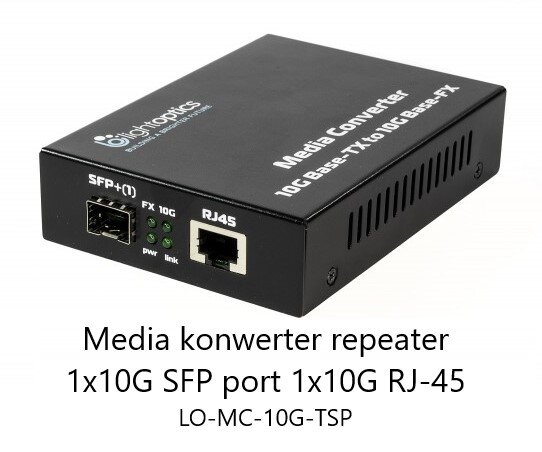
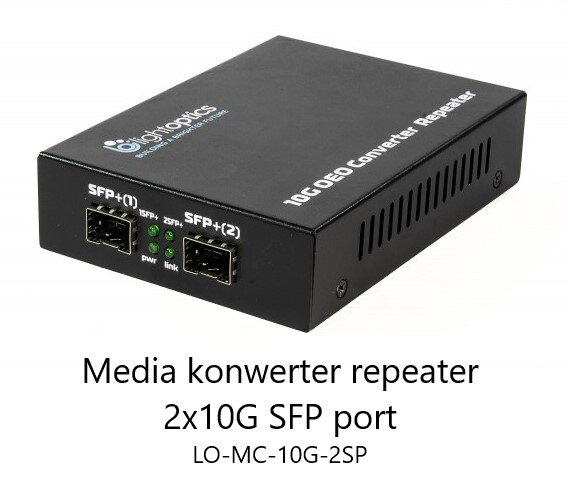
- Increasing data rates: Current media converter speeds are mostly 10/100/1000 Mbps, but some vendors already offer unmanaged 10G converters. Such 10G converters as LO-MC-10G-2SP or LO-MC-10G-TSP are equipped with 1 or 2 SFP+ ports, enabling higher-speed network access over longer distances and offering more options for connecting devices and users to the network. Today this is mainly considered in large data centers, but in the future it will be taken into account in virtually every network upgrade.
- Cost optimization: Power consumption is an important consideration for users, especially in large data centers, because lower power dissipation translates into lower design costs and reduced operating expenses. For smaller deployments, installing a media converter can therefore be a cost-effective solution compared to a network switch.
It should also be noted that continuous advances in fiber technology are, to some extent, reducing production costs of media converters among other products, so over time we can expect their prices to fall.
- Functionality: The number of standards and protocols is increasing, forcing manufacturers to deliver better alignment with new technologies. This is driving the segmentation of the media converter market into unmanaged and managed devices. In the first case, some management and link parameter visibility is lost, but the device does not inspect the transmitted data and transparently extends or converts the network, which improves reliability.
In the second case, management features give much greater control over link parameters and allow better alignment with network requirements, but they demand specialist knowledge for device configuration and ongoing management. These devices are typically more expensive and increase the cost of service deployment.
In summary
The media converter market looks promising due to its wide range of applications, relatively low deployment cost, and simple installation. It is also worth emphasizing that Ethernet twisted pair cabling cannot always be replaced with fiber because of fiber’s larger bend radius and the need to deliver PoE power. Looking at how media converters are evolving technologically, it is almost certain that they will continue to keep up with the growing requirements of operators and the wider market.
Related articles:
Is 1G not enough? We still have 10G!
Transmission beyond 100 m?
Do not want to miss upcoming articles? Subscribe to the newsletter or follow us on: