







Outdoor video surveillance is being deployed more and more widely. It is installed in offices, plants, factories, warehouses, and also in single-family homes due to the rapidly growing smart home trend. It is also used for managing public facilities.
When choosing a camera for surveillance, you should consider not only parameters such as resolution, frame rate, compression, form factor, or the presence of IR technology (allowing recording in the dark), but also – and often most importantly – decide whether you need a wired device (PoE camera) or a wireless device (WiFi camera).
IP cameras that support PoE can send video to the network while receiving both data and power from the same PoE switch (for example, LO-IGS-2GT1GF-POE, LO-IGS-8GT2GF-POE).

An alternative system built on WiFi cameras uses wireless technology that allows cameras to connect to the router over the air. However, wired power is still required. A WiFi IP camera works by sending video footage from the camera to a recorder, which can be accessed on the local network or remotely. This means the user can access the recording through on-premises storage or cloud storage.
PoE camera vs WiFi camera – comparison
Both PoE IP cameras and WiFi IP cameras can provide basic surveillance functions. The differences between them, however, are quite significant.
Advantages of WiFi cameras
• Wireless communication – you only need to place the camera anywhere with access to power, without installing additional cables to connect it to the recorder, which saves time. The only limitation is the power source.
• Aesthetics – WiFi cameras are easier to hide. Using them also saves space and eliminates the need to drill additional holes in walls and damage the building facade.
• Cost savings – typically fewer tools and accessories are required for installation, which makes deployment less expensive.
Disadvantages of WiFi cameras
• Susceptible to interference – wireless cameras are vulnerable to radio interference. Signals from other routers operating on the same band overlap, disrupting camera operation, especially in some residential complexes.
• Limited number of devices – a single router can typically support only about 5–6 wireless cameras.
• Limited range – the biggest drawback of a wireless connection is its limited coverage. All wireless cameras must be within WiFi coverage. The average effective range of routers typically selected for homes and offices is up to about 10 meters. In addition, it is often very difficult to determine the exact range of a WiFi camera, because it depends on the number and structure of obstacles in the path.
• Vulnerable to hacking attacks – network attacks in wired systems are considered impossible here due to authentication and automatic email alerts. In a WiFi network it is relatively easy to spoof the address of an endpoint and send traffic in the same format to connect to the network. Attackers are usually not interested in the camera footage itself; they want access to your data. In some hacking incidents, camera firmware was modified to collect and forward financial data and then send it to the attackers.
Advantages of PoE cameras
• Highly flexible power design – there is no need to worry about a separate power cable. The camera does not have to be installed near a power source because the PoE switch provides power.
• Higher transmission speed – with PoE technology you can obtain from 2.5 Gbps to 5 Gbps over a distance of 100 meters, and even 10 Gbps when using Cat5 and Cat6 cables.
• Higher transmission reliability – data is transmitted over a wired cable to PoE cameras, so it is not susceptible to interference and jamming from wireless signals.
• Longer reach – the maximum connection distance for PoE IP cameras is 100 meters, ten times more than for WiFi. WiFi cameras should be within about 10 meters of the router signal, whereas PoE IP cameras can be installed up to 100 meters from the network switch.
• Better centralized power management – a power outage will shut down the entire video surveillance system if there is no UPS. By moving to PoE technology, you can rely on a single centrally managed UPS that provides backup power for key network devices. It can be switched off or reset remotely, saving both OPEX and time.
Disadvantages of PoE cameras
• More complex installation – installation requires both IT knowledge and basic physical installation skills. To mount a PoE camera you need to drill additional holes in walls or ceilings, and moving the camera later means accepting the leftover holes or renovating walls/ceilings.
• Higher upfront costs – the initial setup of a PoE IP camera system is relatively expensive. It includes the cost of components such as the PoE network switch, PoE-capable Ethernet cabling, PoE IP cameras, and installation services, which are more expensive than for standard WiFi routers.
The graphic below summarizes the main differences between wireless WiFi cameras and wired PoE cameras.

Are you planning to deploy surveillance outside a building, in an unheated hall, or in an industrial enclosure? Read our specialist article on how to power an IP camera and WiFi access point in harsh temperature conditions.
How to make the right choice?
Because both WiFi and PoE cameras have their pros and cons, it is not always easy to make a quick and correct decision. To simplify this choice, it is best to answer the following questions before purchasing: What does my network and power environment look like? What type of application do I want to implement? How many devices do I need to deploy?
To answer these questions, it is worth analyzing several aspects.
First, assess the current network situation together with available power sources. Look at wireless signal strength and coverage along with factors affecting them, such as the type of router used, interference, and signal paths.
Second, check what others are doing. In general, WiFi IP cameras are widely used for home and small office surveillance, while wired PoE IP cameras are installed in outdoor surveillance systems at plants, factories, warehouses, and similar facilities. In addition, wired camera systems are usually selected by homeowners or businesses with a relatively stable way of using the facility, while wireless systems are ideal for tenants or companies in temporary locations.
Third, the size of the area you want to monitor and the number of cameras required strongly influence the choice. If you need to install a single IP camera, for example for home surveillance, you will typically select a WiFi IP camera. However, many homeowners or companies with large properties need comprehensive, high-performance monitoring for the entire area. In such a case, a wired system that can support and connect all cameras is the better solution. Moreover, PoE technology makes the system more flexible when adding, relocating, changing, or temporarily deploying surveillance cameras, which is ideal for future upgrades.
As a general rule of thumb: if you need an easy installation and high flexibility for monitoring a relatively small indoor area, choose wireless WiFi cameras. If you need a stable and scalable network with good management for outdoor applications, choose wired PoE cameras.
An important advantage of PoE cameras that partly reduces deployment cost is the ability to share the cost of some surveillance system components such as the PoE network switch or UPS.
The broad range of PoE switch use cases and the availability of cost-effective models for outdoor applications – which can power not only an IP camera, but also a WiFi access point, POS terminal, VoIP phone, or information display – help reduce the cost of a system based on wired PoE cameras.
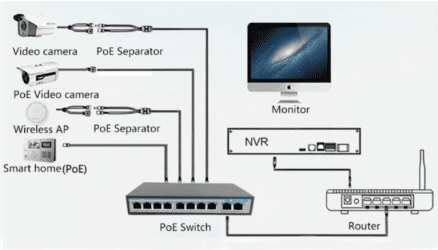
The LightOptics portfolio includes attractively priced PoE switches:
LO-IGS-2GT1GF-POE – industrial switch with 2x PoE 10/100/1000Base-T RJ45 + 1x SFP
LO-IGS-4GT2GF-POE – industrial switch with 4x PoE 10/100/1000Base-T RJ45 + 2x SFP
LO-IGS-8FT2GF-POE – industrial switch with 8x PoE 10/100Base-T RJ45 + 2x SFP
LO-FS-8FT2GT-POE – PoE switch with 8x 10/100Base-T RJ45, 2x 10/100/1000Base-T RJ45 – non-industrial
Example deployments:
- powering surveillance cameras for warehouse space in several branches of a retail chain using the LO-FS-8FT2GT-POE PoE switch model: LO-FS-8FT2GT-POE
- powering high-speed PTZ PoE cameras, touch-screen computers, and Digital Signage displays
Do not miss upcoming articles – subscribe to our newsletter or follow us on: