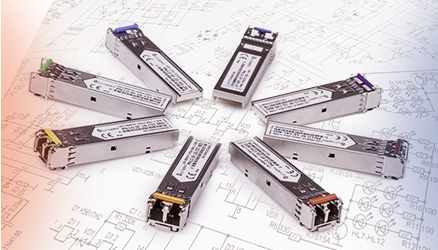








Today, manufacturers of optical transceivers offer a wide range of modules designed to achieve longer distances for 10G transmission over a single optical fiber. This gives us the ability to build large-scale optical networks in an easy and relatively cost-effective way.
Reliable and economical 10G SFP+ single-fiber (BiDi) solutions are also available from LightOptics:
- SFP+ BiDi 20 km 10G optical transceivers:
(LO-SP-10G-2S3-20), (LO-SP-10G-3S2-20)
- SFP+ BiDi 40 km 10G optical transceivers:
(LO-SP-10G-2S3-40), (LO-SP-10G-3S2-40)
- SFP+ BiDi 60 km 10G optical transceivers:
(LO-SP-10G-2S3-60), (LO-SP-10G-3S2-60)
However, as bandwidth demand grows, a data rate of 10 Gbps is no longer sufficient. With the increasing popularity of services such as VoD, cloud, video conferencing, and video gaming, end-user requirements increase every year. The number of network users is rising, as are their expectations regarding link quality. How do we address this? What is next for our network?
Should we simply add more 10 Gbps links? Or should we migrate to higher data rates such as 40 Gbps or 100 Gbps, and if so, how? Will we be forced to lease additional fibers and change the network infrastructure?
Let us therefore look for a single-fiber solution that will allow us to use the resources we already have and avoid raising our own operational costs (e.g. leasing additional fibers).
An interesting and economical way to solve this problem is to use an optical circulator.
Optical circulators operate in the O-band (2nd transmission window) or C-band (3rd window). Their operating principle is based on orthogonal polarization of light traveling in opposite directions, which enables bidirectional transmission on the same wavelength. The diagram below shows a bidirectional transmission topology using circulators.

In an optical circulator, thanks to high directional isolation and low insertion loss between ports, we can transmit and receive a signal at the same wavelength, for example 1310 nm, using just a single optical fiber on the optical path.
Benefits of using circulators
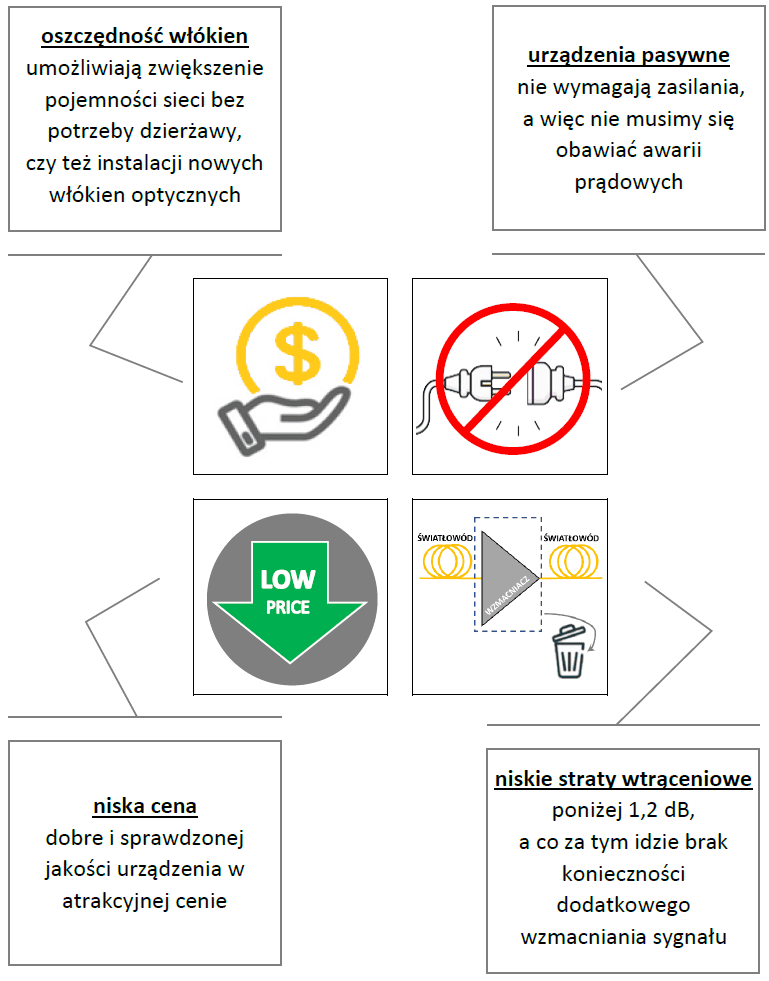
An example of such a device is the LightOptics optical circulator model LO-CIR-010-SCA-1310-NL, a compact unit in an LGX housing with excellent mechanical robustness and built-in SC/APC adapters for convenient installation. It operates reliably without any power supply. It is broadband, operating in the wavelength range 1310 nm±30 nm.

Could we not simply replace the single-fiber 10G transceivers with single-fiber 40G transceivers? Unfortunately, it is not that simple, because 40G transceivers can operate only on 2 optical fibers, and their lasers are built differently from their predecessors, i.e. SFP+, XFP, or SFP modules.
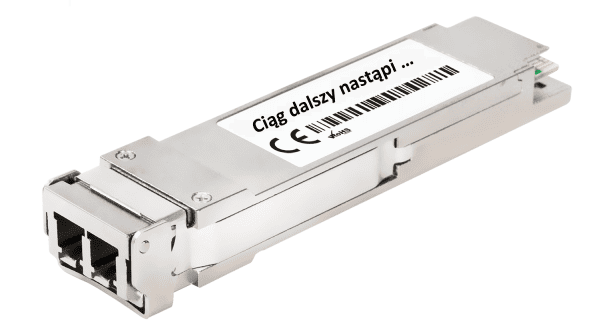
In single-mode QSFP 40G LR4 and ER4 transceivers, we are no longer dealing with just a laser or a set of lasers transmitting a single light beam. To achieve such high data rates over longer distances, a different optical transmission technique was required. These transceivers have built-in miniature CWDM multiplexers and demultiplexers operating on 4 CWDM wavelengths in the second transmission window: 1270 nm, 1290 nm, 1310 nm, 1330 nm. They transmit signals over 2 optical fibers up to approximately 10 km for LR4 and approximately 30 km for ER4, using LC connectors.
The diagram below shows the internal structure of single-mode QSFP 40G LR4/ER4 transceivers.

Examples of such transceivers are:
LO-QSP-40G-LR4-10 – QSFP+ 40G LR4 1310 nm SM LC DDM 10 km optical transceiver
LO-QSP-40G-ER – QSFP+ 40G ER4 1310 nm SM LC DDM 30 km optical transceiver

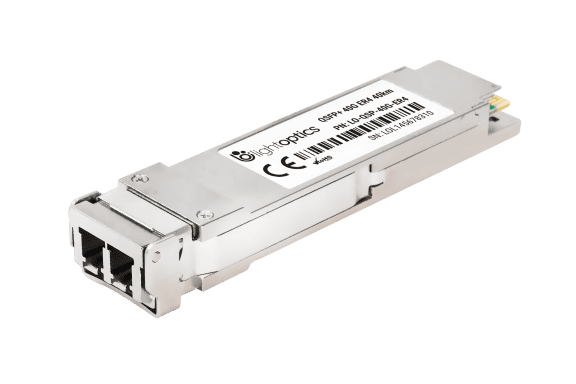
Unfortunately, 40 Gbps transceivers that transmit signals over only a single fiber do not exist.
How do we handle a situation where the main nodes of our network are connected by a single optical fiber, 10 Gbps capacity is no longer sufficient, and there are no 40 Gbps transceivers operating on one fiber?

Assume that our network has 5 main nodes connected in a ring. Individual nodes are interconnected with 10G SFP+ single-fiber transceivers, similar to what is shown in the diagram below.
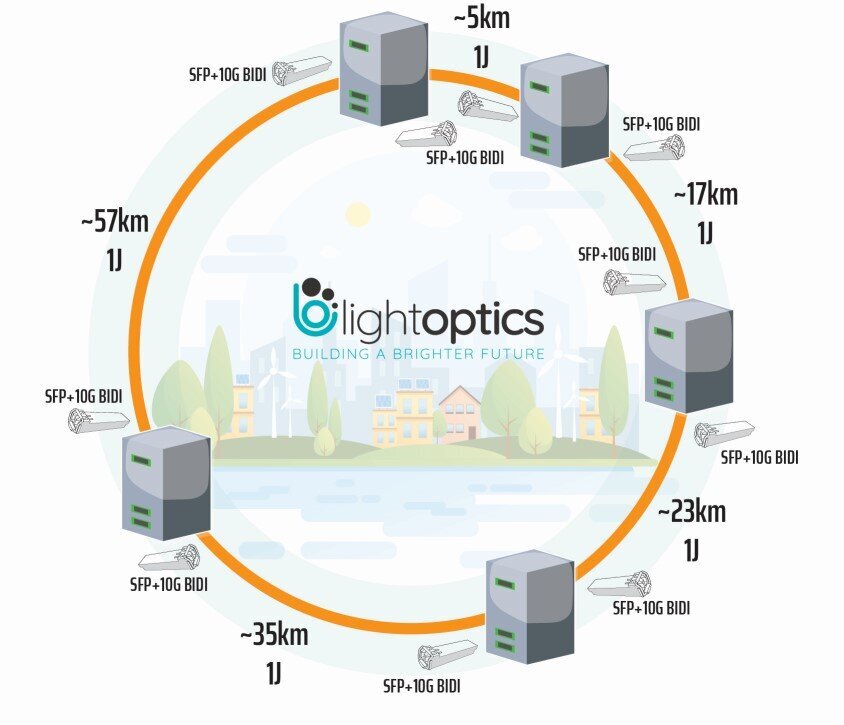
To migrate to 40G, having at our disposal only optical transceivers operating over 2 optical fibers for distances up to 10 km (QSFP+ LR4) and up to 30 km (QSFP+ ER4), we can use an optical circulator operating in the 2nd transmission window (same as 40 Gbps transceivers). This gives us the ability to use only one optical fiber instead of two.
When designing such a solution, the following aspects must be taken into account:
- Transceiver link budget:
LR4 model: LO-QSP-40G-LR4-10 = 4.5 dB
ER4 model: LO-QSP-40G-ER = 16.3 dB
- Circulator insertion loss:
model: LO-CIR-010-SCA-1310-NL ≤ 1.2 dB
- Fiber span attenuation:
for 1310 nm wavelength approximately 0.35 dB/km
We have selected the solution and know the operating parameters of the chosen devices, so we can move on to calculations.
Calculations for LR4 transceivers:
4.5 dB – 2 × 1.2 dB = 2.1 dB
2.1 dB / 0.35 dB = 6 km
Conclusion:
Using LR4 transceivers (LO-QSP-40G-LR4-10) together with circulators (LO-CIR-010-SCA-1310-NL) allows us to build links up to approximately 6 km. We can therefore safely use this solution for the shortest 5 km link in our ring.
Calculations for ER4 transceivers:
16.3 dB – 2 × 1.2 dB = 14.9 dB
14.9 dB / 0.35 dB = 42 km
Conclusion:
Using ER4 transceivers (LO-QSP-40G-ER4) together with circulators (LO-CIR-010-SCA-1310-NL) allows us to build links up to approximately 42 km. We can therefore use this solution for the remaining links in our ring, i.e. 17 km, 23 km, and 35 km.
What can we do if the distance is greater than 40 km?
How do we handle the longest 57 km link in our ring?
What if I need more than 1 x 40G?
We will answer these and other questions soon in the next articles.
Do you want to make sure you do not miss the next articles? Subscribe to the newsletter or follow us on: