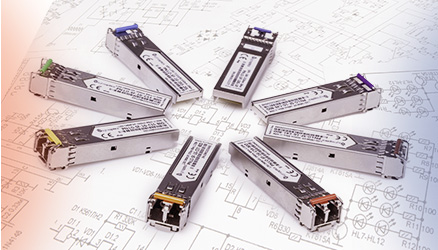
40 Gbps transceivers are available in multimode and single-mode versions and differ significantly from their 10 Gbps predecessors. 40 Gbps optical transceivers are manufactured in a different form factor, namely QSFP+ (Quad Small Form-Factor Pluggable), and are available with female MPO/MTP 12‑fiber and LC connectors (where MTP is an enhanced version of the standard MPO; both names are used interchangeably). These modules no longer use just a single laser/transmit diode as in 1 Gbps or 10 Gbps pluggables. In this article we will look at them more closely and describe the basic 40 Gbps transceiver models.
If you want to see the technical specifications or you are looking for specific models for your network, check the available 40G QSFP+ optical transceivers in our shop.
Do you know what came first: the MPO connector or 40 Gbps optical transceivers?
The MPO connector appeared first, and only later was it used in, among others, 40 Gbps optical transceivers. The emergence of this connector type was a response to the need to densely pack fibers in a single adapter and to terminate in a single connector the most popular MTP ferrule with 12 fibers. Thanks to this, a single MPO adapter provides 12 fibers. Today MPO connectors are available not only as MPO 12F, but also MPO 24F and even MPO 72F, which allows building large networks without the need for substantial expansion of the existing infrastructure.
In a standard 12‑fiber MPO connector only 8 outer fibers are used, because we only need to transmit 4 channels at 10 Gbps, which corresponds to 40 Gbit in each direction.
Modules with MPO/MTP 12 connector

MPO 12F connector schematic; red pins are assigned to TX (transmit), green pins are assigned to RX (receive), and white pins are not used.

To connect two 40 Gbps modules we use crossed MPO cables, so that the transmitted signal (TX) is delivered to the receiving diode (RX).
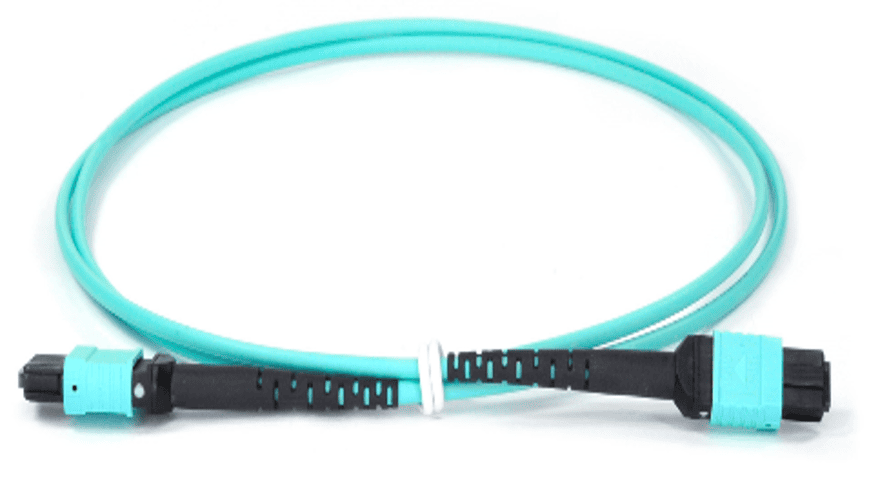
Modules with MPO connectors use 4 pairs of optical fibers for data transmission and support links over both multimode and single-mode fibers. In the case of multimode QSFP+ SR4 pluggables they operate using 4 x 850 nm 10 Gbps lasers, whereas single-mode QSFP+ LR4 PSM pluggables use 4 x 1310 nm 10 Gbps lasers. Each lane carries data at 10 Gbps.

Construction diagram of the laser in 40 Gbps SR4 optical modules
40G QSFP+ MPO pluggables: on the transmit side the transmitter converts parallel electrical input signals into parallel optical signals by means of a laser array. The parallel optical signals are then transmitted simultaneously through the multimode MTP fibers. On the receive side the receiver converts the parallel optical input signals into parallel electrical output signals via a photodetector array.
Types of 40 Gbps modules
- QSFP+ 40 Gbps SR4
Multimode QSFP+ 40 Gbps SR4 MPO pluggables with VCSEL (vertical-cavity surface-emitting lasers) operate over OM3 fiber at distances up to 100 m, and over OM4 fiber up to 150 m.
- QSFP+ 40 Gbps eSR4
Multimode QSFP+ 40 Gbps eSR4 MPO pluggables with CML (chirp-managed directly modulated laser) use a DFB laser (distributed feedback laser) combined with an optical filter. This is reflected in the name of this laser type, where the word “chirp” refers not to bird sounds but to the change in instantaneous frequency or wavelength of the optical pulse over time. Advantages of using a CML laser include low power consumption, small size, and high performance enabling long transmission distances. eSR4 pluggables over OM3 fiber support distances up to 300 m, and over OM4 fiber up to 400 m.
The multimode QSFP+ 40 Gbps SR4 module can also be used in 4 × 10 Gbps mode to interoperate with 10G SR modules. Such connectivity is achieved using a special breakout cable with an MPO connector on the 40G‑SR4 side and duplex LC connectors on the 10G SR side (the so‑called breakout “octopus” cable).

- QSFP+ 40 Gbps LR4 PSM – module with angled MPO connector
Single-mode QSFP+ 40 Gbps LR4 PSM pluggables use DFB lasers (distributed feedback lasers), i.e. diode lasers with distributed feedback. These modules support distances up to 10 km; due to the use of DFB lasers they are significantly more expensive than 40G SR4 modules.
These are the only single-mode optical modules with an MPO connector.
This pluggable is usually selected because of the invaluable, in some applications, ability to easily split a single‑mode 40 Gbps signal into 4 independent 10 Gbps transmissions (for this purpose passive breakout cables, the so‑called “octopus” cables, are used).
In this module type, to minimize reflections caused by the MPO connection, a slightly different MPO adapter is used, with an 8‑degree angled endface, and a female MPO connector with an 8‑degree polished endface must be used (as in the drawing below).

- Instead of QSFP+ 40 Gbps transceivers we can also use cables:
- 40 Gbps DAC cables (Passive Direct Attach Cable), i.e. copper cables terminated on both sides with a QSFP+ plug, which work very well in short‑reach 40 Gigabit Ethernet applications over distances of a few meters. Their clear advantage is low cost, while the disadvantage is limited reach; passive DAC cables are recommended for distances up to 7 m.
- 40 Gbps AOC cables (Active Optical Cable), i.e. fiber optic cables terminated on both sides with QSFP+ modules, more expensive than their copper counterparts, capable of transmitting data over longer distances: up to 300 m on OM3 fiber and up to 400 m on OM4 fiber.
- 40 Gbps Breakout DAC cables – passive cables that allow connecting a device with a QSFP+ port to 4 devices with SFP+ ports over a short distance.

THE SECOND PART OF THE ARTICLE, WHERE WE TAKE A CLOSER LOOK AT QSFP+ 40G: – 40 Gbps modules with LC connector
Do not miss the next articles – sign up for the newsletter or follow us on: