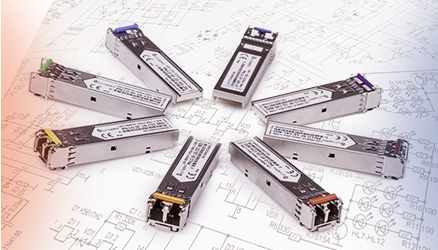








The LC (little connector) fiber optic connector is by far the most popular connector type used in optical transceivers. It owes its popularity to several aspects: mechanical stability, compact size that allows deployment in high‑density patching areas, a latch lock system that protects against accidental unplugging, and the characteristic click that confirms correct insertion. LC connectors are available in simplex and duplex variants, with two polishing types: UPC (flat) and APC (angled), and for both single-mode and multimode fiber.
40 Gbps modules with LC connector
Modules in this format support links over both multimode and single-mode fiber.

QSFP+ 40 Gbps LR4 and ER4
In single-mode QSFP+ 40 Gbps LR4 and ER4 transceivers we are no longer dealing only with a single laser or a simple set of lasers transmitting a light beam. To achieve such high data rates over longer distances, a different light transmission technique is required. These transceivers integrate miniature CWDM multiplexers and demultiplexers operating on four CWDM wavelengths from the second transmission window: 1270 nm, 1290 nm, 1310 nm, 1330 nm. They transmit the signal over two optical fibers up to approx. 10 km for LR4 and approx. 30 km for ER4; the connector type is LC.

In single-mode 40 Gbps QSFP+ LC optical transceivers, four 10 Gbps serial data streams on the transmit side are passed to the laser drivers. DFB lasers equipped with laser drivers control directly modulated DML lasers. The output signal from the four DML lasers is then optically multiplexed into the LC‑terminated fiber cable, combined into a single 40 Gbps optical signal. On the receive side, the 40 Gbps optical signal is demultiplexed into four individual 10 Gbps channels with different wavelengths. Light at each wavelength is collected by PIN or APD receiver diodes and then output as electrical data after amplification by a TIA (transimpedance amplifier). Unlike 40G QSFP+ transceivers with MPO interfaces, 40 Gbps QSFP+ transceivers with LC interfaces cannot be broken out into 4 × 10 Gbps, because they use four wavelengths over a single pair of single-mode fibers.
QSFP+ 40 Gbps LX4
QSFP+ 40 Gbps LX4 modules with LC connector transmit data up to 150 m over OM3 fiber and up to 2 km over single-mode fiber. These transceivers also integrate miniature CWDM multiplexers and demultiplexers operating on four CWDM wavelengths. They are slightly more expensive than LR4 modules, but their key advantage is the ability to operate over both multimode and single-mode fiber.
40GBASE-BiDi (Bi-Directional)
40 Gbps multimode modules with LC connector
There are no 40 Gbps optical modules that transmit the signal over a single fiber, so where does the name for this type of module come from? Standard 40 Gbps multimode modules transmit over eight fibers, carrying a total of 4 × 10 Gbps, that is 10 Gbps over each fiber pair. In modules known as 40GBASE-BiDi, the signal is transmitted over only a single pair of fibers (two fibers), which is why they are referred to as BiDi. Multimode modules with LC connectors are not very popular and their use is limited.
Basic types of 40 Gbps transceivers by connector type and fiber type
40 Gbps (QSFP+) | MPO connector modules | Max. distance (MPO) | LC connector modules | Max. distance (LC)
multimode | QSFP+ 40 Gbps SR4 | 100 m on OM3, 150 m on OM4 | 40GBASE‑BiDi | 100 m on OM3, 150 m on OM4
multimode | QSFP+ 40 Gbps eSR4 | 300 m on OM3, 400 m on OM4 | – | –
single-mode / multimode | – | – | QSFP+ 40 Gbps LX4 | 150 m on OM3, 2 km on SMF
single-mode | QSFP+ 40 Gbps LR4 PSM | 10 km on SMF | – | –
single-mode | – | – | QSFP+ 40 Gbps LR4 | 10 km (20 km*) on SMF
– | – | – | QSFP+ 40 Gbps ER4 | 30 km on SMF
SMF – single-mode fiber
OM3 – OM3 multimode fiber
OM4 – OM4 multimode fiber
If you want to see the technical specifications or you are looking for specific models for your network, check the available QSFP+ 40G optical transceivers in our store.
40 Gbps multimode or single-mode transceivers?
Single-mode fiber (SMF) has much tighter tolerances for the optics used. The core is smaller and the laser wavelength is narrower, which means SMF can support higher bandwidth and much longer transmission distances. 40 Gbps QSFP+ transceivers with LC interfaces are typically used for long‑distance data transmission over SMF.
Multimode fiber (MMF) uses a significantly larger core and usually a shorter light wavelength (850 nm). For this reason, the optics used in MMF have a higher capability to collect light from the laser. 40 Gbps QSFP+ transceivers with MPO interfaces are typically deployed for short‑reach transmission over MMF.
Do not miss upcoming articles – sign up for our newsletter or follow us on: