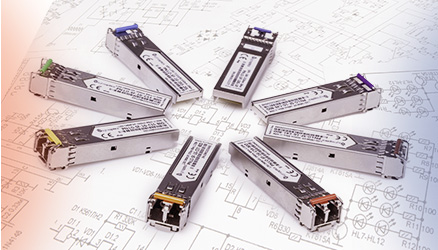
High data transfer rates are critical for switches, routers, and media converters. Typical line rates are 1 Gbps, 10 Gbps, 25 Gbps, 40 Gbps, 100 Gbps, and even higher. Below we present the most popular interface types at 40 Gbps and 100 Gbps, focusing on the distances they support.
40G optical modules
40G optical modules use the QSFP+ (Quad Small Form-Factor Pluggable) form factor and are available with MPO and LC connectors. A module with an MPO connector uses 4 pairs of optical fibers for data transmission, whereas a module with an LC connector has a built-in multiplexer that allows 4 independent transmissions, each at a different wavelength (1270 nm, 1290 nm, 1310 nm, and 1330 nm), to be carried over the same fiber. Modules in this form factor support links over both multimode and single-mode fibers. At the time of writing, the maximum distances achievable with such modules are approximately 30 km.
When we look more closely at 100G transmission, we immediately notice the variety of interface types – CFP, CFP2, CFP4, QSFP28…
QSFP28 100G module
A QSFP28 100G module combines four SFP28 modules in one housing. It enables data transmission in one of two standards, i.e. 100 GbE and/or OTU4. Modules in this form factor can implement links that, on the optical side, use 1 lambda at 100 Gbps, 2 lambdas at 50 Gbps, or 4 lambdas at 25 Gbps. They can be used over both single-mode and multimode fibers and support transmission over distances of up to 80 km, without external optical amplifiers.
CFP/CFP2/CFP4 100G module
In turn, CFP/CFP2/CFP4 100G transceivers support line rates from 103.1 Gbps to 111.8 Gbps. These were the first modules on the market that allowed operators to exceed the 100 Gbps threshold. Due to their size and power consumption, this technology loses out to QSFP28 modules in point-to-point links over single-mode or multimode fibers. They are, however, the only hot-swap modules that support coherent transmission at both 100 Gbps and 200 Gbps. Current technology does not yet allow power consumption for such coherent modules to be reduced enough to fit them into a QSFP28 form factor. CFP/CFP2/CFP4 100G modules allow services to be delivered over both single-mode and multimode fiber and support transmission over distances of up to 80 km, without external optical amplifiers.
Based on typical 40 Gbps and 100 Gbps schemes, interfaces are divided by transmission type (multimode and single-mode), standard (QSFP+, QSFP28, CFP, CFP2, CFP4), and supported distance.

100 Gbps transceivers transmit data over four channels at 25~28 Gbps:
- Transmission over multimode fiber (MPO12 connector)
- Transmission over two single-mode fibers (LC connector)
Due to the different transmission technologies used by 100 Gbps modules, you cannot mix different interface types within a single link. In the overview we included the transmission lambdas of the modules and examples of optical connector calculations broken down by interface.
40G TRANSCEIVERS:
- QSFP+ 40G SR4 850nm MPO DDM MM 150m optical transceiver - Model LO-QSP-40G-SR4
- QSFP+ 40G LR4 1310nm SM LC DDM 10km optical transceiver - Model LO-QSP-40G-LR4-10
- QSFP+ 40G ER4 1310nm SM LC DDM 30km optical transceiver - Model LO-QSP-40G-ER
100G TRANSCEIVERS:
- QSFP28 100Gbs SR4 850nm MPO DDM MM 100m SINGLE RATE optical transceiver - Model LO-QSP28-100G-SR4
- QSPF28 100Gbs LR4 1310nm LC DDM SM 10km SINGLE RATE DML+PIN optical transceiver - Model LO-QSP28-100G-LR4
Do not miss our new technical articles – subscribe to the newsletter or follow us on: