

As technology evolves and bandwidth demand keeps growing, new interface types appear in network devices such as switches, routers, media converters and firewalls.
Ethernet switch interface speed is a critical design factor and typically ranges from 1G, 10G, 25G, 40G up to 100G and beyond. Below is an overview of the main interface types supporting these data rates.
The most widely used are SFP and SFP+ interfaces.
Main Ethernet interface types:
RJ45
RJ45 (Registered Jack type 45) is the standard for copper connectors. An RJ45 port on a switch transmits Ethernet traffic at 10/100/1000/10000 BASE speeds and can be used in data centers to connect servers as well as in LAN environments. Standard Ethernet patch cords usually follow these categories: Cat 5/5e/6/6a, and are commonly used to connect two RJ45 ports.


GBIC
GBIC (Gigabit Interface Converter) is an older, now rarely used interface type, based on Ethernet standards and designed for conversion between optical and electrical media, with hot-swap construction. It was used in Ethernet and Fibre Channel networks.
A GBIC module has an SC optical connector and transmits data up to 1.25 Gb/s. It operates with multimode and single-mode fiber (2-fiber and single-fiber) and is also suitable for CWDM operation. These modules can transmit data over distances up to 120 km.
The GBIC standard is non-proprietary and was defined by the Small Form Factor committee. The first publication was released in November 1995. The technical editor was Robert Snively from Brocade Communications and the committee members included AMP Incorporated, Compaq Computers, Sun Microsystems and Vixel Corporation.


SFP
SFP (Small Form-Factor Pluggable) is a compact interface that allows a higher port density than GBIC, which is why it is also called mini-GBIC. It is used to convert between optical and electrical media. SFP interfaces are deployed not only in Ethernet networks, but also in SONET, Fibre Channel and other industrial standards. They provide data rates from 100 Mb/s for Fast Ethernet up to 4 Gb/s for Fibre Channel.
SFP optical transceivers are equipped with LC or SC optical connectors (for optical transmission) and with an RJ45 copper connector for Gigabit Ethernet. They operate over multimode and single-mode fiber and are also suitable for CWDM and DWDM operation. They can transmit data over distances up to 200 km. SFP transceivers are hot-swappable.
They support diagnostic functions: DDM/DOM, enabling real-time monitoring of operating parameters. They provide information on transmitted and received optical power, operating temperature, bias current and supply voltage.
SFP optical transceivers are commonly available in several categories:
- SFP SX – wavelength 850 nm, distance up to 550 m,
- SFP LX – wavelength 1310 nm, distance up to 20 km,
- SFP EX – wavelength 1310 nm, distance 40 km,
- SFP ZX – wavelength 1550 nm, distance 80 km,
- SFP EZX – wavelength 1550 nm, distance 160 km,
- SFP BX (also called BiDi) – wavelength 1550 nm/1310 nm (less commonly 1490 nm/1310 nm).
There are also modules designed for CWDM systems – 18 available channels for both the second and third transmission windows – and DWDM systems – 48 channels for systems with a 100 GHz grid and 96 channels for systems with a 50 GHz grid. SFP 1000BASE-T are Gigabit Ethernet SFP modules that operate over copper cabling.

SFP+
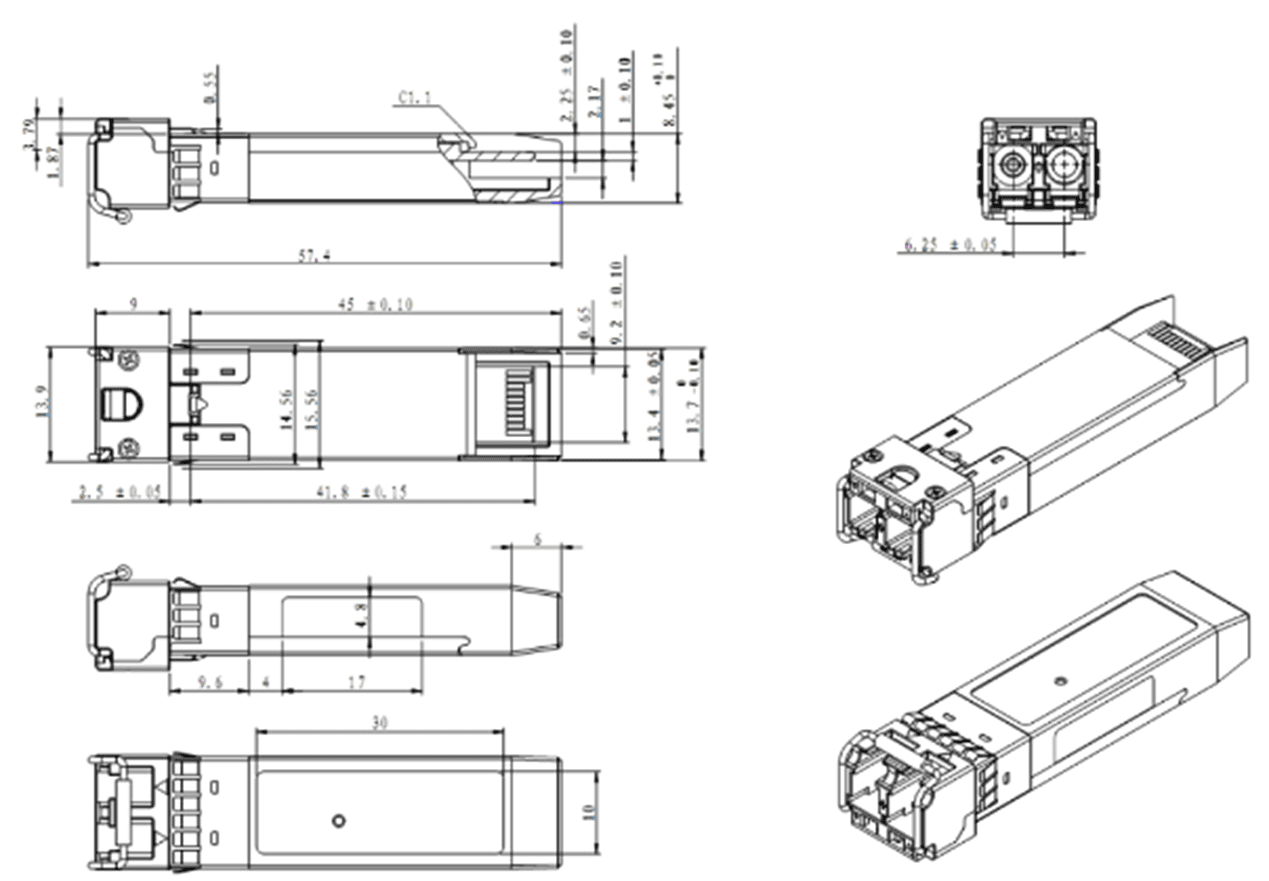
SFP+ (Enhanced Small Form-Factor Pluggable) is a compact optical interface. These interfaces are used not only in Ethernet networks, but also in SONET, Fibre Channel and other industrial standards. They provide data rates from 8 Gb/s (Fibre Channel) and 10 Gb/s (Ethernet) up to 16 Gb/s Fibre Channel. The first SFP+ specification was published in 2006, while the currently applicable version 4.1 was published in 2009.
From both construction and diagnostic perspectives, SFP+ transceivers are almost identical to SFP transceivers.
SFP+ optical transceivers are commonly available in several categories:
- SFP+ SR – wavelength 850 nm, distance up to 300 m,
- SFP+ LR – wavelength 1310 nm, distance up to 10 km or 20 km,
- SFP+ ER – wavelength 1550 nm, distance 40 km,
- SFP+ ZR – wavelength 1550 nm, distance 80 km,
- SFP+ BX – wavelength 1270 nm/1330 nm, distance up to 40 km.
As with SFPs, SFP+ transceivers can operate in both CWDM and DWDM systems.
XFP
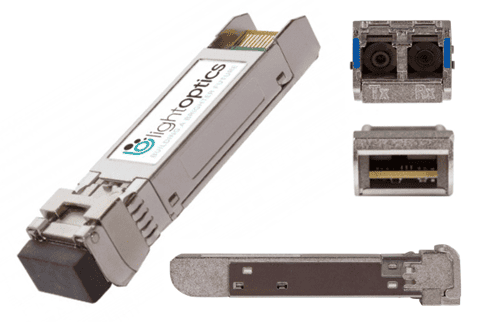
XFP (10 Gigabit Small Form Factor Pluggable) is an interface that supports data rates from 9.95 Gb/s to 11.1 Gb/s. It is designed for use in SONET, Ethernet and OTN networks.
The XFP specification was created by the XFP Multi Source Agreement Group (an informal industry group not officially backed by any institution). The first specification was completed on 27 March 2002 and released to the public on 19 July 2002 (minor changes were introduced on 31 August 2005). The XFP group chair was Robert Snively from Brocade Communications Systems and the technical editor was Ali Ghiasi from Broadcom.
XFP transceivers have LC or SC optical connectors. There are versions for both single-mode and multimode fibers, as well as models intended for CWDM and DWDM wavelength-division multiplexing systems.
XFP optical transceivers are commonly available in several categories:
- XFP SR – wavelength 850 nm, distance up to 300 m,
- XFP LR – wavelength 1310 nm, distance up to 10 km or 20 km,
- XFP ER – wavelength 1550 nm, distance 40 km,
- XFP ZR – wavelength 1550 nm, distance 80 km,
- XFP BX – wavelength 1270 nm/1330 nm, distance 40 km.

XENPAK
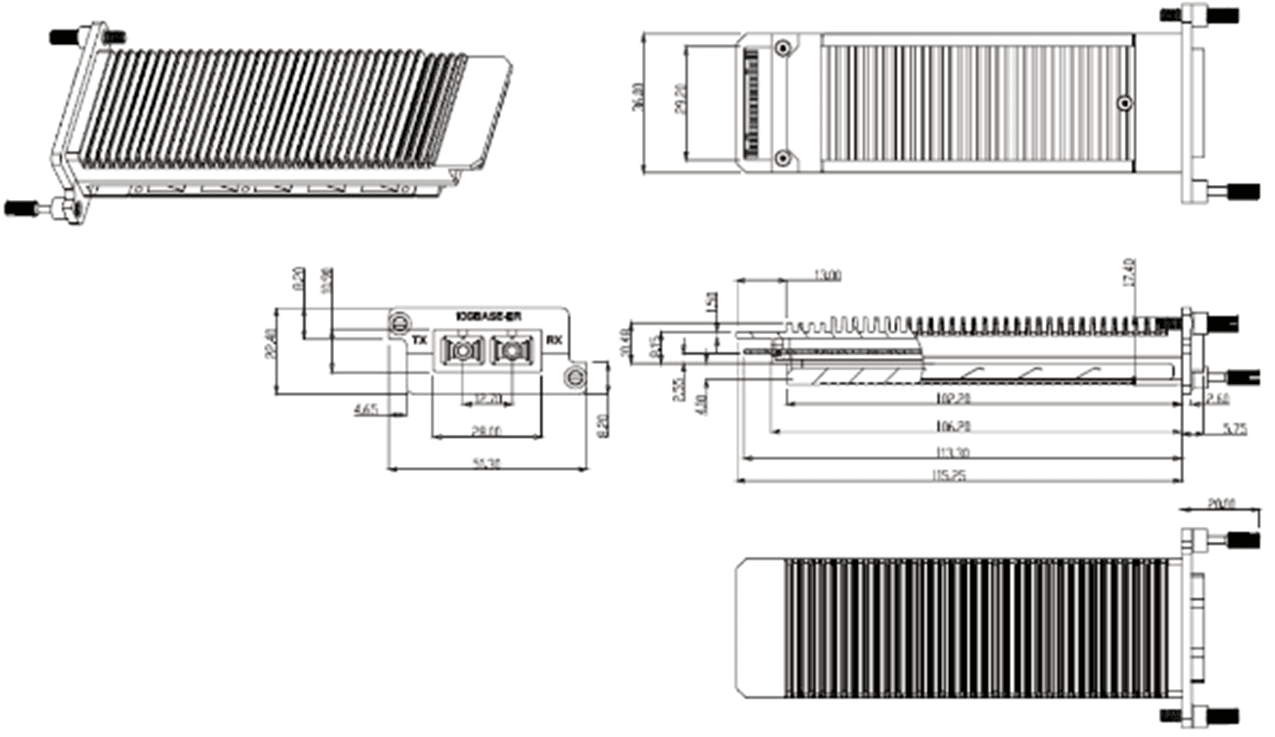
XENPAK is a standard published in 2001 under an MSA (Multi Source Agreement). The latest version of this standard, 3.0, dates from 2002.
XENPAK modules have SC optical connectors. They can also operate with InfiniBand copper cables with CX4 connectors (supporting distances up to 15 m). They are hot-swappable.
Today, XENPAK modules have been replaced by smaller modules such as XFP or SFP+, which provide the same functionality.

X2
X2 is a standard published in 2002, derived from the XENPAK standard.
X2 modules can be used in 10 Gigabit Ethernet, SONET/SDH and Fibre Channel networks.
Just like the original XENPAK, X2 has now largely been replaced by XFP or SFP+ modules.


SFP28
SFP28 is a 25 Gbit/s interface that evolved from SFP+ transceivers. At the time of writing, it is mainly used for 25 Gb Ethernet and 32G Fibre Channel connections.
QSFP+
QSFP+ (Quad Small Form-Factor Pluggable) can be described most simply as four SFP+ modules in a single housing. On the optical side, it transmits the signal over four independent 10 Gbps lanes.
QSFP+ modules are available with MPO and LC connectors. A module with an MPO connector uses four pairs of optical fibers for data transmission, whereas a module with LC connectors has an integrated multiplexer that allows four independent transmissions, each on a different wavelength, to be carried over the same fiber. Modules in this form factor can be used over both multimode and single-mode fibers. At the time of writing, the maximum distance achievable with these modules is approximately 30 km.


QSFP28
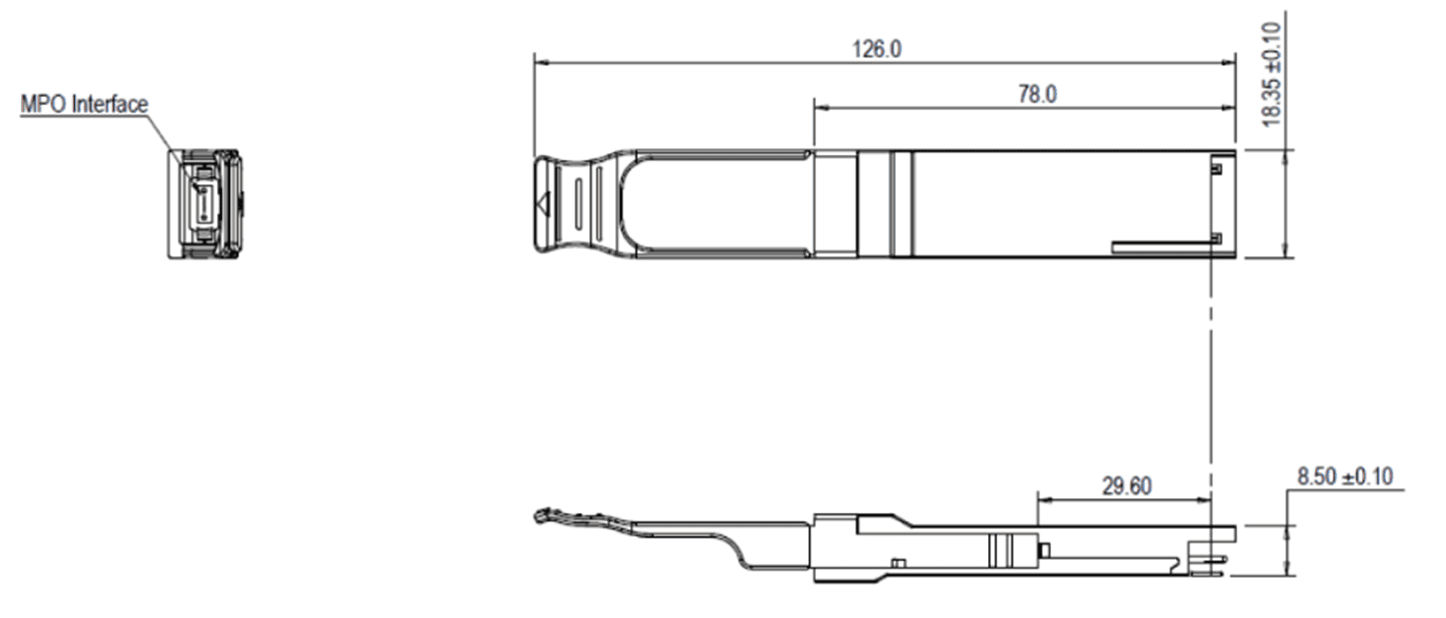
QSFP28, just as QSFP+ combines four SFP+ modules, combines four SFP28 modules in a single form factor. It enables data transmission in either of two standards, i.e. 100 GbE and/or OTU4. Modules in this format allow connections using one 100 Gbps lambda, two 50 Gbps lambdas or four 25 Gbps lambdas. They support services over both single-mode and multimode fiber and enable transmission over distances up to 80 km without using external optical amplifiers.
CFP/CFP2/CFP4 100G
CFP/CFP2/CFP4 100G is an interface family that supports data rates from 103.1 Gb/s to 111.8 Gb/s. These were the first modules on the market that allowed operators to exceed the 100 Gbps threshold. Due to their physical size and power consumption, this technology loses out to QSFP28 transceivers, especially for point-to-point transmissions over single-mode or multimode fiber. However, they are the only hot-swap modules that enable coherent transmission at both 100 Gbps and 200 Gbps. Current technology does not yet allow the power consumption of such coherent modules to be reduced sufficiently to fit them into a QSFP28 housing.
Do not miss upcoming articles. Subscribe to the newsletter or follow us on: