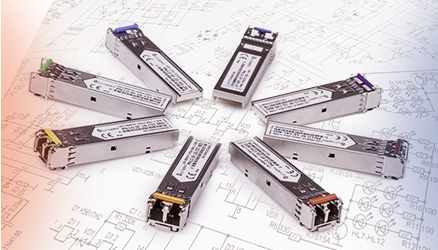








Why do we keep asking this question?
Third-party optical transceivers have been present on the Polish market for over a decade, yet only the last few years have brought their widespread adoption. Earlier concerns about choosing this type of solution were linked mainly to the fact that leading network equipment manufacturers often refused warranty support if so-called third-party transceivers were used in their devices. Today, users are far more informed and the attitude of manufacturers has changed. We know that if we use transceivers from another manufacturer in a given vendor’s devices, we do not lose the warranty. If a network device – for example a switch, router, or media converter – is damaged, the seller is obliged to honour the warranty under applicable consumer protection laws, which prohibit refusing warranty support solely on the basis of using non-approved equipment, unless it can be verified that the damage was caused by that equipment (in this case by the optical transceiver). Fortunately, OEM manufacturers’ approach to warranty support is slowly changing and the market is becoming increasingly open to third-party optics.

Another common and still current reason for concern about using third-party transceivers is uncertainty regarding their compatibility with a particular vendor’s device. Manufacturers often block the use of third-party optics by continuously modifying and updating the software of their devices so they support only their own transceivers. More aspects related to compatibility of third-party optical transceivers with OEM devices will be covered soon in a separate article.
One of the main reasons why OEM vendors refuse warranty support when so-called third-party optical transceivers are used, and why they technically block the possibility of using such modules, is their desire to protect revenue from sales of their own optics.
Do we really have to buy expensive original vendor-branded transceivers to avoid these issues?
The answer is NO. It is enough to use good, proven-quality third-party modules with technical parameters equivalent to the original and compliant with applicable standards. Optical transceivers should be manufactured in accordance with MSA (Multi-Source Agreement) specifications, provide good optical parameters, transmit power (TX), receiver sensitivity (RX) and a link budget equal to that of the original module, and use efficient transmitter and receiver laser diodes.
Let us now take a closer look at the physical design and build quality of the transceiver.

A very important aspect indicating the quality of optical transceivers is the cleanliness of the optical interfaces. Most manufacturers of low-cost third-party modules clean only the receiver side, but leave the laser facet uncleaned. This degrades the quality of such a device, because any contamination in the optical path significantly reduces performance.

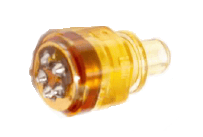
Another important component to pay attention to is the optical isolator, and in practice its presence, because some third-party manufacturers, in order to cut production costs, produce optical transceivers without an isolator. It is located between the transmitter and the fiber end face (in the Tx path) so that reflected light and backscattered signals from the fiber do not interfere with transmitter operation. The presence of an isolator improves transmission quality by eliminating corrupted frames. Light is scattered not only at the connector, but also on micro-cracks in the laser diode, and the result of this scattering is that reflected light returns to the transmitter, disturbing laser operation. This is particularly important on short transmission distances.
How critical the presence of an isolator is can be seen from the transmission test results below, performed using a VIAVI MST 5800-100G tester. A 24-hour BERT test (JUMBO 9600 frame) was performed by looping each module back with a physical fiber loop (one module at a time in the same port) using the same patch cord throughout the entire measurement.

The repeatability of PCB design and manufacture translates directly into the ability of an optical transceiver to achieve and maintain compatibility with the active device in which it is installed. Unfortunately, it often happens that optical transceiver manufacturers do not pay attention to changes in PCB layouts, resulting in devices with non-repeatable PCB architectures. This lack of repeatability causes a transceiver to work flawlessly with a given network device and be correctly detected in one case, and in another case to be incorrectly detected or even completely invisible to the device.

The quality of PCB contact pins also often leaves much to be desired. Poor-quality pins wear out when transceivers are inserted into and removed from the network device multiple times, whereas according to the MSA standard they should withstand 250 such insertion/removal cycles in an active device port.
Optical parameters are not everything; in optical transceivers, the type of transmitter and receiver diode is also very important.
Transmitter diodes used in multimode modules:
- LED (light-emitting diode),
- VCSEL (vertical cavity surface-emitting laser).
Transmitter diodes used in single-mode modules:
- FP (Fabry-Perot),
- DFB (distributed feedback),
- DML (directly modulated lasers),
- EML (electroabsorption modulated laser).

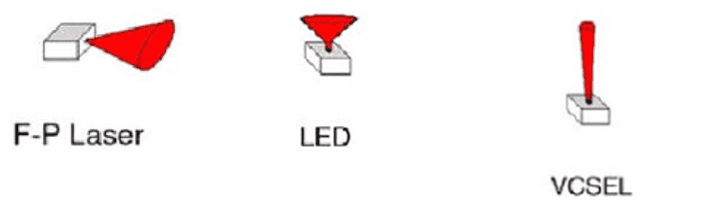
Differences between transmitter diodes are influenced by:
- the type of material from which the diode is made,
- the presence of a quartz resonator in front of the diode (stabilizing oscillation frequency),
- output power,
- beam directionality,
- chromatic dispersion coefficient (pulse broadening).
Types of receiver diodes:
APD (avalanche photodiode)
- very high-sensitivity light detector,
- the number of photons required to generate a signal with a satisfactory bit error rate (BER = ratio of the number of errors to the number of transmitted bits) is significantly lower than for PIN, and therefore APD is more sensitive,
- used for longer distances,
- more expensive (4 times the cost of PIN).
PIN (positive intrinsic negative photodiode)
- cannot be saturated by excessive optical power in normal operation,
- used for short distances,
- cheaper.
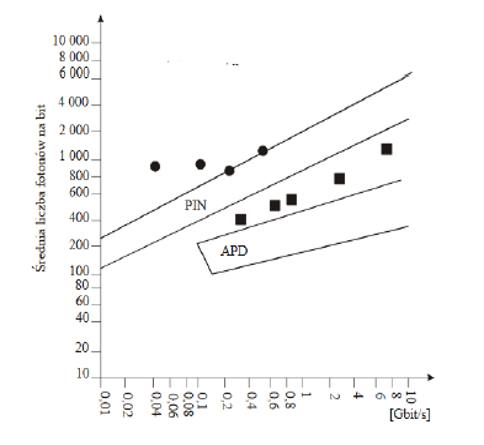
For example:
An SFP+ 10G CWDM module (1270–1390 nm) 23 dB with a DFB transmitter and APD receiver allows a maximum distance of up to 60 km, while an analogous optical module with a PIN receiver, i.e. SFP+ 10G CWDM (1270–1390 nm) 23 dB with a DFB transmitter and PIN receiver, makes it possible to reach a maximum distance of up to 30 km.
A QSFP+ 100G ER 1550 nm optical module with an EML transmitter and APD receiver enables a distance of 40 km, whereas an analogous module with a PIN receiver, i.e. QSFP+ 100G ER 1550 nm with EML transmitter and PIN receiver, allows a distance half as long, i.e. 20 km.
Using poor-quality third-party transceivers leads to serious issues, in particular excessive heating. Network devices are usually densely packed in racks, which hampers proper heat dissipation and requires efficient, well-calibrated ventilation. Everyone wants to use available rack and data center space as efficiently as possible; this space is often expensive, especially when leased from another operator, a data center, or an Internet Exchange Point. In such an environment, overheating of low-quality transceivers, which may additionally cause device reboots or hangs, can be both irritating and costly.
We now know the main problems associated with using low-end third-party optical transceivers, but they do not apply to all of them. The market also offers very good third-party optical modules whose quality, reliability, and compatibility are at a very high level, and the components used to manufacture them often come from the same factories that supply OEM vendors.
Answering the question posed at the beginning, we can confidently say that it is worth using third-party transceivers, but they must be of good quality, because only then will they actually reduce your costs.
How can you identify and find high-quality optical transceivers in the jungle of online offers?
Today’s reality is an enormous volume of offers flooding the market, making it difficult to find a good, trustworthy product that is not only attractively priced but also compatible and stable in operation as a replacement for OEM optics. Do you really need to verify MSA compliance, check cleanliness of laser and receiver facets, analyze PCB repeatability, assess pin quality, train yourself in laser technology, and on top of that solve compatibility questions? The answer is: not necessarily. It is enough to choose solutions that have already been thoroughly verified by a distributor who also provides pre- and post-sales support.
When you select a product, in this case a third-party optical transceiver, you typically analyze aspects such as price, fast delivery, warranty, reliability, shipping cost, and purchasing security.
At Fibermarkt we have been supplying optical transceivers for 10 years and we maintain local stock in Poland. We rely on the LightOptics brand, offering transceivers that combine wide compatibility with low price, proven as replacements for OEM optics. Like other third-party modules, they are manufactured in the Far East, but it is us at Fibermarkt who continuously develop their compatibility and work to ensure they track changes in network devices and firmware versions on the market. Before releasing products for sale, our engineers subject them to rigorous tests and analysis (they check the cleanliness of laser and receiver facets, repeatability of PCB manufacture, perform endurance tests, etc.). They also verify options for configuration changes needed to adapt optical modules to work with different network devices.
Our 10 years of experience allow us to support our customers in selecting and deploying solutions as part of pre- and post-sales technical support.

LightOptics are proven, high-quality transceivers working with devices from most leading network and telecom equipment manufacturers. The optical modules are manufactured in accordance with MSA (Multi-Source Agreement) specifications and meet all electrical and electromagnetic requirements. LightOptics transceivers come with a full warranty and support DDM (Digital Diagnostic Monitoring), which enables monitoring of key operating parameters such as transmit optical power, received optical power, and operating temperature.
Our modules are used by ISPs, telecom operators, integrators, administrators, and installers.
The LightOptics optical transceiver portfolio includes:
Technologies:
Duplex, Simplex (WDM/BIDI), CWDM, DWDM, Copper
Data rates:
1.25 Gbs, 10 Gbs, 40 Gbs, 100 Gbs
Form factors:
SFP, SFP+, XFP, QSFP, QSFP28, DAC
Compatibility:
Our optical transceivers interoperate with devices from most leading network and telecom equipment manufacturers.
Do not miss upcoming articles. Subscribe to our newsletter or follow us on: