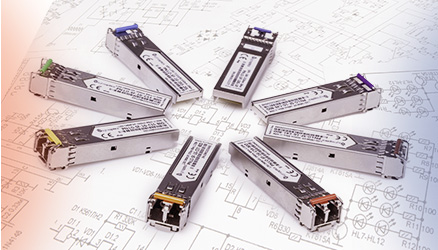
QSFP+ optical transceiver is a compact, hot-swappable fiber module used for data communications. It is undoubtedly one of the milestones in the development of modern networking technologies. Compact, energy-efficient and high-performance QSFP transceivers are based on a four‑channel data transmission architecture. The technological path opened by QSFP+ continues in newer generations such as 100G QSFP28, and also 400G QSFP‑DD and 800G QSFP‑DD/OSFP.

What does QSFP+ stand for?
The name QSFP+ (Quad Small Form-factor Pluggable Plus) precisely describes the nature of this module:
- “Quad” means four-channel data transmission,
- “Small Form-Factor” refers to the compact mechanical size of the module,
- “Pluggable” indicates easy hot-swappable installation in a switch,
- “Plus” indicates higher data rate than its predecessor (10G SFP+) – QSFP+ provides 40 Gb/s throughput.
Where are QSFP+ modules used?
QSFP transceivers are an optimal choice where space savings and energy efficiency are critical. They are widely used in data centers, service provider networks, and institutional networks such as government and higher education. QSFP+ optical transceivers are particularly useful when upgrading an existing 10G network thanks to their ability to break out a 40G signal into 4x10G.
Energy savings
When designing a transport network or operating a data center, you cannot ignore energy efficiency. Efficient power usage and cooling are key to maintaining optimal performance and lowering OPEX. QSFP+ modules are well suited to these requirements. Depending on the specific model and data rate they typically consume only 1.5 to 3.5 watts.
How does a QSFP+ optical transceiver work and which connector types does it use?
As an optical transceiver, QSFP+ converts an electrical signal into an optical signal and back, enabling data transmission over fiber optic cabling. These modules are characterized by processing four independent information channels, also referred to as lanes. Transmission over fiber is implemented via MPO (Multi‑Fiber Push‑On) or LC (Little Connector) connectors. Depending on the connector type, signals are carried in different ways.
MPO connectors
For modules with an MPO interface, data transmission runs over a 12‑fiber cable, of which only eight fibers are actively used: four for transmit (TX) and four for receive (RX). This allows efficient bandwidth utilization and helps minimize signal loss.


The MPO interface with four TX and four RX pairs (four lanes) allows the 40G signal to be broken out into four independent 10G transmissions. This is implemented using breakout cables, also called fan‑out cables. Such a cable enables you to connect a 40G QSFP+ module to four 10G SFP+ ports on one or more switches.

LC connectors
Another approach uses QSFP+ modules with LC fiber connectors. These modules leverage Coarse Wavelength Division Multiplexing (CWDM) technology. They employ four optical signals (four lasers), each operating at a different wavelength. Four separate wavelengths are combined into a single optical signal by the CWDM system and transmitted over a single fiber pair in a process called multiplexing. At the far end, the remote QSFP+ module reverses this process (demultiplexing), converting one optical signal back into four separate electrical channels which are then delivered to the network equipment.
The key advantage of this type of module is that it uses only two fibers for data transmission, which simplifies migration from 10G to 40G while retaining the same 2xLC connector type. With QSFP+ transceivers using MPO, migration from 10G to 40G requires increasing the number of fibers from 2 to 8 and changing the front‑panel connector type from 2xLC to MPO‑12.

Common types of 40G QSFP+ optical modules
Different network requirements call for different optics. QSFP+ module variants differ mainly in supported transmission distance, but also in the underlying technology. The most popular types include:
- 40G QSFP+ SR4 – Multimode modules using MPO connectors and VCSEL lasers at 850 nm. They support distances up to 100 meters over OM3 multimode fiber and up to 150 meters over OM4.
- 40G QSFP+ LR4 – Single-mode modules with 2xLC/UPC connectors. They use CWDM technology, transmitting four wavelengths from 1270 nm to 1330 nm. Datasheets and descriptions often list only an average wavelength value, i.e. 1310 nm. They support distances up to 10 kilometers.
- 40G QSFP+ ER4 – Single-mode modules with 2xLC/UPC connectors. Functionally similar to QSFP+ LR4, but designed for longer distances of up to approximately 30 km.
- 40G QSFP+ LX4 – Modules with 2xLC/UPC connectors that also use CWDM technology. They work with both multimode and single-mode fiber. Typical reach over OM3 multimode fiber is up to 150 meters, and up to 2 kilometers over single-mode fiber, enabling flexible deployment options.
- 40G QSFP+ BiDi (Bi-Directional) – Multimode modules with 2xLC/UPC connectors that use bidirectional data transmission over just 2 fibers instead of 8, making them a cost‑effective option for many applications. They support up to 100 meters on OM3 and up to 150 meters on OM4.
- 40G QSFP+ DAC – Two QSFP+ endpoints connected by a copper cable, used for short, intra‑rack or row‑level connections over a few meters inside the data center.
QSFP technology evolution – toward ever higher data rates
Over the past several years QSFP technology has evolved toward increasingly higher line rates. As the world becomes more data‑driven, higher bandwidth and lower latency have become critical. The evolution has followed this path:
- QSFP: The first QSFP generation supporting up to 4 Gbps using four 1 Gbps channels.
- QSFP+: An enhanced QSFP version supporting up to 40 Gbps with higher performance and lower power consumption.
- QSFP28: Modules supporting up to 100 Gbps. They are a standard choice for applications requiring higher bandwidth and better energy efficiency.
- QSFP-DD: A QSFP variant supporting up to 400 Gbps with eight 50 Gbps lanes. Thanks to its double density, QSFP‑DD is ideal for next‑generation data centers that demand maximum performance. 800G QSFP‑DD modules are already available on the market.
- QSFP56: A 200G optical transceiver generation that bridges the gap between QSFP28 and QSFP‑DD.
The continuous evolution of the QSFP family makes these modules a fundamental building block of modern data centers, driving the development of future network infrastructure. It is expected that QSFP‑based technologies will continue to gain importance for many years to come.